

For 65 days each winter, the sun disappears from this town.
Everyone leaves.
They say it’s because of vampires.
They say it’s safer that way.
This year, someone stays.
Not to fight monsters.
But to find out who they are without light touching them.
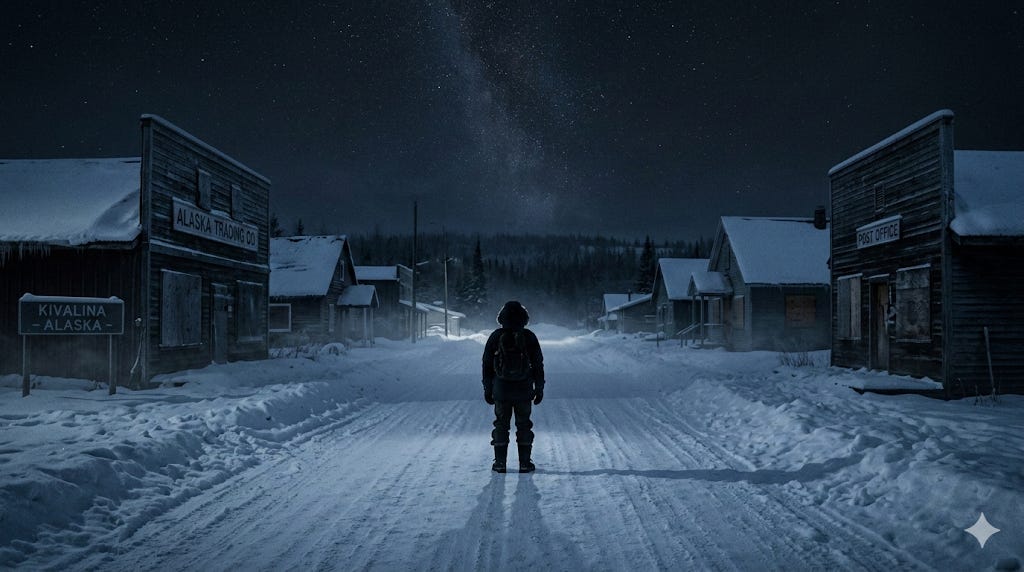
65 Days Without Being Seen
The last sunset of the year looked embarrassed.
It slid behind the black spruce like it was trying not to be seen leaving, smearing the horizon with a thin bruise of orange that couldn’t hold its shape. Clouds caught fire for a minute, then cooled into ash. Snow turned the color of old pennies and then into nothing at all.
That was the part people watched.
They watched the sky, and they didn’t watch each other.
Engines idled in driveways. Doors slammed. The town moved with practiced speed, not frantic, just obedient. Like they’d been trained for this their whole lives.
I stood on my porch with my hands in my pockets and tried to feel whatever I was supposed to feel.
For years, that was the ritual too. We gathered our winter bodies and left behind our summer selves. We made jokes we’d told before. We promised to come back. We did not talk about what we were actually doing.
We did not talk about why the streetlights were already off.
We did not talk about the way the houses looked when the boards went up, like a town preparing for a storm that came from inside.
“Don’t be stupid,” my mother said, hugging me too hard. “You come with us.”
“I’m staying.”
She searched my face for the reason she could argue with.
Because I’m tired.
Because I don’t know who I am when you’re looking at me.
Because the version of me you love feels like a costume I’ve been wearing so long I forgot it wasn’t skin.
“I just want to see,” I said.
“See what?”
“What happens. If I don’t leave.”
Her jaw tightened.
“That’s what the vampires want,” she said.
Not like a joke. Not like an old story. Like ice. Like fire. Like something you named so you could survive it.
She grabbed my shoulders.
“Lock your shadow,” she whispered.
“What does that mean?”
Her eyes flicked away.
“It means don’t let the dark take what the light gave you.”
Then she climbed into the truck and drove away without looking back.
The bell in the center of town rang once as the sun slipped out of sight.
After that, the world began to close.
The first week was mostly quiet.
I kept the generator running in the evenings, more for the hum than the light. I cooked simple meals. I read. I slept when I felt tired.
The windows were black mirrors now.
Glass stopped being something you looked through and became something that looked back.
I caught myself checking the porch as if someone might be standing there. The habit of being watched lingered long after the watchers were gone.
On the tenth day, I walked into town.
The streets were plowed, but snow softened the edges of everything. Signs were dark. Stores were boarded. The air smelled like cold iron.
I stood in the middle of Main Street and listened.
Nothing.
No wind. No engines. No distant voices.
Just my own breathing.
It felt wrong to be heard.
I laughed once, to prove I could.
The sound came out thin and unfamiliar, like someone else trying on my mouth.
I didn’t laugh again.
Time loosened after that.
Without the sun, there was no leash pulling me from one version of myself to the next. Morning didn’t demand productivity. Evening didn’t demand reflection. There was no gentle shift in light reminding me how to behave.
Sleep became a suggestion. Hunger drifted in and out like a tide.
On the fifteenth day, I couldn’t tell how long I’d been awake.
On the twentieth, I ate dinner twice.
On the twenty-third, I realized I hadn’t spoken to another human being since my mother left.
The silence inside my skull had changed shape. It had become a room.
And in that room, something waited.
I started avoiding mirrors.
Not because they moved wrong.
Because they didn’t.
In the dim light, my face lost definition. My eyes looked darker, less like eyes and more like holes. I stared and felt like I was watching a stranger practice being me.
I raised a hand. He raised his.
I said my name.
It sounded staged.
Like a line in a play.
I said it again.
The syllables slid off my tongue without landing anywhere inside me.
On the thirtieth day, I stopped shaving. There was no one to read my face.
On the thirty-third, I stopped wearing the clothes I wore when people might see me.
On the thirty-fifth, I realized I was still doing certain things as if someone might grade me.
Washing dishes immediately. Folding laundry neatly. Sitting up straight.
Even alone, I was performing.
For the version of myself that lived in other people’s eyes.
The whispers didn’t come as voices.
They came as memories.
My father’s hand on my shoulder when I was a kid, guiding me forward in a room full of people. The pressure that said be good. be normal. be what they want.
A teenage version of me under fluorescent light, practicing expressions in a bathroom mirror.
A funeral where I cried at the wrong time and someone looked at me like I had failed.
The memories arrived without commentary.
They opened doors I had nailed shut.
After each one, the silence grew heavier.
After each one, the person I’d been in daylight felt less anchored.
I began taking long walks at random hours, letting the darkness swallow me. The stars were sharp and merciless when the clouds cleared.
With no sun, the sky did not feel like an eye.
It felt like an absence.
And something in me relaxed.
That was the first frightening part.
Not the fear.
The relief.
On Day Forty-Seven, I stopped missing the sun.
I was sitting at the kitchen table, a mug of coffee cooling in my hands, darkness pressed against the windows.
And I felt calm.
Not numb.
Not sad.
Calm in a way I had never felt in daylight.
In daylight, even alone, there was always the sense of being visible. Of being shaped. Of being expected.
In darkness, the roles fell away.
I did not have to hold my face a certain way.
I did not have to anticipate the next question.
I did not have to be legible.
On Day Forty-Seven, I realized I had never met myself before.
The thought did not make me panic.
It made me hungry.
Not for blood.
For whatever existed beneath all the careful behavior.
I turned off the generator that night and sat in the dark.
When my eyes stopped fighting it, something else opened.
I could feel my breathing without commentary.
I could feel my thoughts without editing them.
I could feel how much of my identity had been built out of light.
Not sunlight.
Social light.
The light of being perceived.
In true darkness, there was no perception.
Only presence.
And I liked it.
That was the second frightening part.
I stopped turning lights on after that.
I moved through the house by touch and memory. I stopped thinking of myself by name. The name felt like a tag someone else had tied to my wrist.
Useful for others.
Less useful for me.
One night, walking through the empty town, I saw my shadow stretch faintly across the snow beneath the stars.
It looked too close. Too eager.
For a moment, it felt like it was not following me.
It was leading.
Lock your shadow.
I looked down at it.
“Where would I even put you?” I whispered.
The shadow shifted, thin and patient.
And I understood.
The part of me I had kept locked in daylight was not dying in the dark.
It was waking up.
The first hint of spring was not warmth.
It was color.
A faint paling at the edge of the horizon that looked almost accidental.
The town would return soon.
They would ask questions. They would want teeth and blood and something they could point to.
They would want a monster.
It would be easier that way.
The truth was quieter.
The truth was that the dark strips away the audience.
And without an audience, the performance dies.
The sky brightened another shade.
I felt grief.
Not because I feared what the darkness held.
Because I feared what the daylight demanded.
The light would ask me to become legible again. To put my name back on. To smile at the right times.
Something had happened here.
I could feel it under my skin, like new bone.
I had shed something.
And I did not know how to pick it back up.
The horizon thinned toward gray.
I looked down at the snow beside my boots.
A faint shadow lay there.
It did not look like mine anymore.
It looked like a door.
I whispered my name one last time.
It did not answer.
And that felt right.
When the sun rises, I do not.
Maybe the town never feared creatures in the dark.
Maybe it feared what the dark reveals.
When the audience disappears, so does the performance.
And not everyone wants to meet what’s left.
If you had 65 days without being seen, who would you become?
If this one unsettled you in a quiet way, share it.
Comment: would you stay… or would you leave?
And if you’ve ever felt like your identity shifts depending on who’s watching, you’re not alone.
More bent stories every week.
Terrific! But I think I might not last that long in the dark. So well written! Thanks for these short stories! ✨
I would stay it sounds like a brief taste of heaven