

Some doors appear suddenly.
Others wait patiently for years beneath the shape of ordinary life.
This is another standalone story inside the growing world of Pandemonium… a place hidden somewhere beneath memory, grief, transit systems, fluorescent lights, and the quiet parts of ourselves we try not to examine too closely.
You do not need to read the previous story to enter.
But if you’ve ever walked through your home at night and felt like something about it was subtly wrong…
you may already know the hallway.
Approaching Pandemonium
Daniel noticed the hallway the moment he stepped inside the apartment.
Not consciously at first. Just the small internal hesitation of a brain brushing against something wrong.
He stood in the doorway with a plastic grocery bag hanging against his leg while rainwater dripped from his jacket onto the carpet. Somewhere down the hall, a television murmured through thin walls. A laugh track rose, broke apart, and vanished.
The apartment smelled faintly of dust, wet fabric, and the garlic bread turning cold inside the bag.
Daniel locked the door behind him. Deadbolt. Chain. Habit.
He took three steps forward before stopping.
The hallway seemed longer tonight.
Not dramatically longer. Not haunted-house longer. Just enough that his body noticed before his thoughts did. The bathroom door should have been immediately to his left. Instead, there were two more steps between it and the front entrance.
Daniel stood motionless.
Rain tapped against the balcony glass beyond the living room. The fluorescent light above the kitchen sink buzzed with the same tired electrical hum it had carried for months.
Maybe always.
He frowned and walked forward again, counting without meaning to.
One.
Two.
Three.
Four.
Five.
Bathroom door.
His chest tightened.
It had always been three.
Hadn’t it?
Daniel stared at the cheap beige carpet, at the flattened fibers and the dark stain near the closet from when the water heater leaked last winter. Everything looked normal, which somehow made it worse.
He laughed once under his breath.
“You’re tired,” he muttered.
The words disappeared into the apartment without weight.
He set the groceries on the counter and unpacked them mechanically. Bread. Soup cans. Microwave dinners. Generic cereal. Food purchased by a man who had stopped imagining future versions of himself.
The fluorescent light flickered once overhead.
Daniel froze automatically now when lights flickered. That had become another habit.
Nothing happened.
The buzzing steadied.
He exhaled and continued unpacking.
The apartment still looked half moved into, despite the fact that he had lived there for years. Boxes remained stacked near the living room wall, some unopened since before the transit.
Or after it.
The timelines had started slipping again.
On the kitchen table sat three yellow sticky notes in his own handwriting.
CALL PHARMACY
TAKE MEDICATION
DO NOT FALL ASLEEP ON COUCH AGAIN
Daniel stared at the last note longer than the others.
He could not remember writing it.
That was no longer unusual. The first few times had terrified him. Now it mostly exhausted him.
He opened the freezer and slid in the microwave dinners one at a time. Halfway through, he paused.
There was already a box of the same brand inside.
Same flavor.
Same quantity.
Had he gone shopping yesterday?
This morning?
The memory floated just beyond reach, submerged beneath dark water.
Daniel closed the freezer harder than necessary. The sound echoed too long through the apartment, and for a moment he thought he heard something beneath it.
Metallic.
Distant.
Like train tracks shifting somewhere underground.
He stood still and listened.
Nothing.
Just plumbing in the walls. Rain outside. Fluorescent hum.
He grabbed the grocery receipt from the counter and stared at the timestamp.
11:42 PM.
Tuesday.
At least he thought today was Tuesday.
He folded the receipt carefully and slid it into the junk drawer before realizing the junk drawer was almost completely empty.
Right.
Packing.
Transit.
The suitcase.
His eyes moved toward the hallway closet.
The old brown suitcase sat exactly where he had left it earlier that week. Scuffed leather. Crooked wheel. Blank identification tag.
Something about its presence distorted the emotional gravity of the apartment, as if the room itself understood it was temporary now.
Daniel looked away first.
The microwave clock blinked 12:00.
Power outage again.
Or maybe he had forgotten to reset it.
He could no longer tell which explanation frightened him more.
The fluorescent bulb dimmed suddenly overhead. Not off. Just weaker. The apartment softened into bruised yellow light, then stabilized.
Daniel’s pulse climbed anyway.
He moved to the living room window and parted the blinds.
Rain silvered the parking lot below. Streetlights trembled in oily puddles. Somewhere nearby, tires hissed across wet pavement.
Ordinary.
Everything looked painfully ordinary.
Usually that helped.
Tonight it didn’t.
Tonight the apartment felt like it was waiting for him to notice something.
His gaze drifted back toward the hallway.
Five steps.
Not three.
Five.
The doctor had called it cognitive drift. Stress-related spatial distortion wasn’t technically impossible. Sleep deprivation could affect perception. Trauma rewired strange corners of the brain.
Daniel repeated these things internally the way people repeated prayers they no longer believed but were afraid to abandon.
He walked slowly toward the hallway again.
One.
Two.
Three.
Four.
Five.
Bathroom door.
His stomach tightened harder this time.
The hallway wasn’t just longer.
It felt deeper.
As though the apartment extended farther inward than its exterior dimensions allowed.
Daniel placed a hand against the wall beside the bathroom.
Cold drywall.
Solid.
Normal.
Still, he stood there listening.
Somewhere beyond the walls came a low mechanical groan. Not pipes. The sound rolled beneath the building, heavy enough that he felt it faintly through the floor before it faded.
His chest went tight.
Train tracks.
The thought arrived instantly.
Recognition.
The same subterranean vibration from before.
From transit.
Daniel stepped backward.
“No,” he whispered.
The word sounded embarrassingly small.
He rubbed both hands over his face hard enough to hurt.
Sleep deprivation. Anxiety. Memory damage.
That was the explanation.
It had to be.
Because the alternative meant the transit system had not ended when he came home.
And part of him already knew that was true.
That was the worst part.
Not fear.
Recognition.
The hallway light flickered again.
This time, when darkness swept briefly across the apartment, Daniel saw something impossible.
A shape in the hallway wall.
Tall. Narrow. Vertical.
The outline of a door where no door had ever been.
Then the light steadied.
Blank wall again.
Daniel stopped breathing.
Rain whispered against the windows. The fluorescent bulb buzzed overhead. Far below the building, something metallic screamed against unseen rails.
Daniel did not turn on the bedroom light.
He sat awake in the dark instead, fully dressed, listening to the apartment breathe around him.
The clock beside the bed read 1:13 AM.
Then 1:13 again twenty minutes later.
Then 1:13 again.
At some point he stopped checking.
Rain continued outside in soft uneven waves. Pipes knocked inside the walls like distant footsteps traveling through the building’s bones. Every few minutes, the fluorescent light in the kitchen emitted a faint electrical click, even though he had switched it off hours ago.
Daniel kept staring toward the bedroom doorway.
Toward the hallway beyond it.
Waiting for the outline to return.
You’re exhausted, he told himself.
But exhaustion didn’t explain the sound beneath the floor.
Or the strange pressure inside his chest every time he looked toward the hallway.
Homesickness turned rancid.
Around what he guessed was 2 AM, thirst finally drove him from the bed.
The apartment felt colder immediately.
Not winter cold.
Underground cold.
Airless cold.
Daniel stepped carefully into the hallway.
And stopped.
The hallway had changed again.
His stomach folded inward.
It was longer now. Undeniably longer.
The bathroom door no longer sat a few feet from the bedroom. It looked distant, not impossibly distant, just wrong enough that the proportions of the apartment collapsed quietly inside his head.
The fluorescent light overhead buzzed weakly, casting sick-colored shadows across the carpet.
Daniel counted automatically.
One.
Two.
Three.
Four.
Five.
Six.
Seven.
Bathroom door.
His pulse thudded hard once.
The closet sat farther down now too.
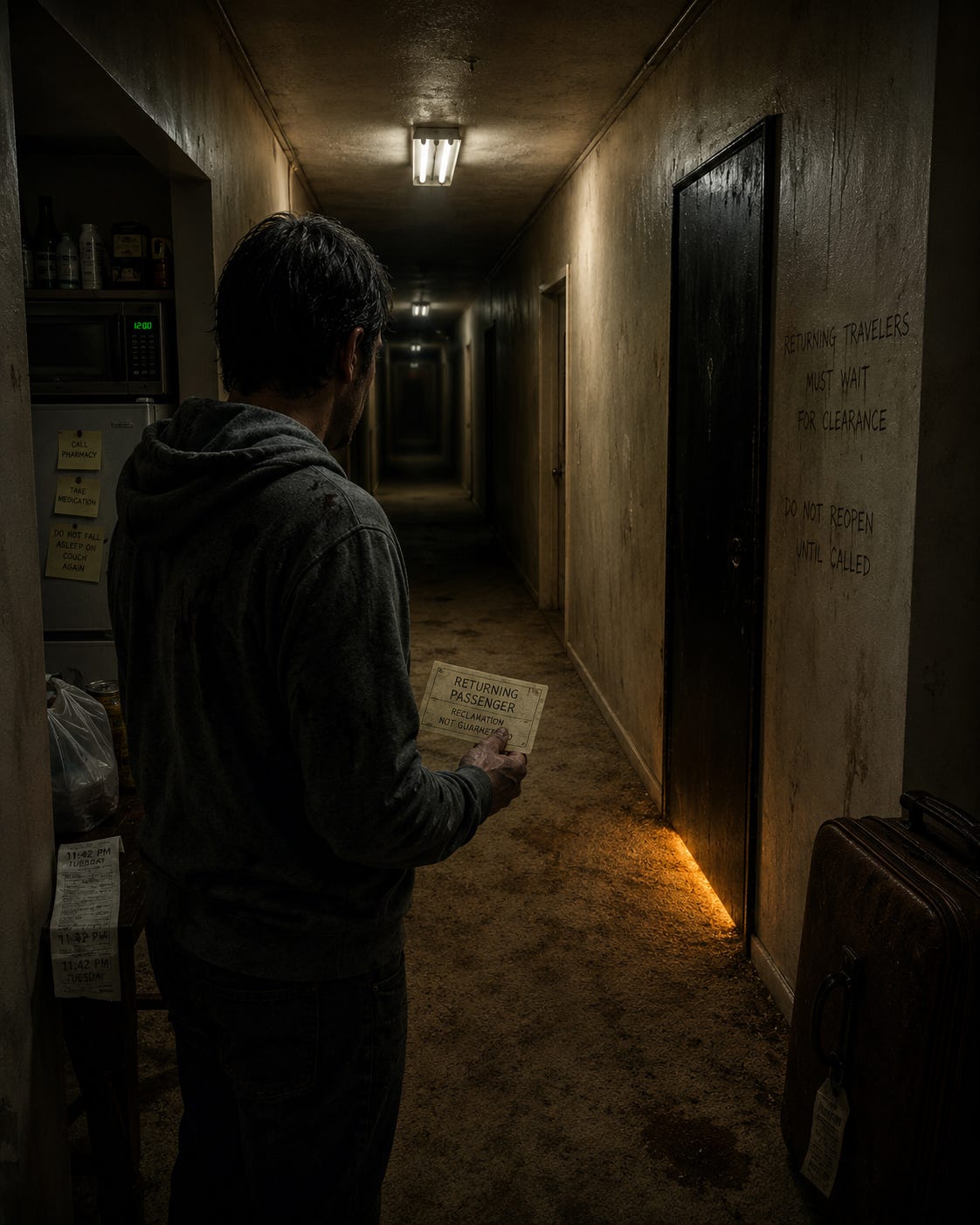
And between them, where blank wall should have been, was a door.
Daniel did not move.
For several seconds, his brain refused to process what he was seeing.
The door was narrow and black, its paint dull with age. No frame molding. No visible knob. Just a vertical seam cut into the hallway wall like something inserted there afterward.
Thin amber light glowed beneath it.
Warm light.
Not apartment light.
The hallway suddenly smelled of wet concrete and old paper.
Daniel’s mouth went dry.
“No,” he whispered again.
But the word carried no conviction this time.
Because deep down, beneath panic and logic and exhaustion, he recognized the door.
Not visually.
Emotionally.
The way people recognize places from childhood they have not seen in decades. A pressure behind the ribs. A familiarity without narrative.
Daniel stepped forward before realizing he had decided to move.
The carpet beneath his feet felt slightly damp now.
The fluorescent hum deepened overhead, lower than before, like machinery idling somewhere far below the building. His eyes fixed on the strip of light beneath the door.
It flickered softly.
Not electrical flickering.
Movement.
As though shadows were passing on the other side.
Daniel stopped an arm’s length away.
The apartment around him had gone impossibly quiet. No pipes. No rain. No neighboring televisions.
Only the hum.
And beneath it, something else.
Rolling wheels.
Faint.
Suitcase wheels crossing tile.
Daniel’s heartbeat stumbled.
Then came voices.
Muffled. Layered. Impossible to make out clearly. Dozens maybe. Conversations overlapping beyond the door like an airport terminal heard through thick walls.
He strained to listen.
Most of it dissolved into static.
Then one sentence surfaced briefly.
“Platform change now arriving…”
The announcement crackled away before finishing.
Daniel stared at the door.
A shallow scratch marked the paint near eye level.
Words.
He leaned closer.
The letters looked carved with something sharp and hurried.
RETURNING TRAVELERS
MUST WAIT
FOR CLEARANCE
Below that, nearly hidden beneath older scratches:
DO NOT REOPEN
UNTIL CALLED
Cold spread slowly through Daniel’s arms.
The procedural tone made it worse.
Not demonic. Not theatrical.
Administrative.
Like this was all completely normal somewhere else.
His gaze dropped to the light beneath the door. It pulsed softly. Warm amber, then dim, then warm again.
Like breathing.
Daniel realized he was holding his own breath.
He stepped backward.
Immediately the hallway seemed shorter.
Not normal.
But closer.
The pressure in his chest eased slightly.
He stopped, then took one cautious step forward.
The hallway deepened again.
The realization hit hard enough to turn his stomach.
The hallway was responding to proximity.
Or he was.
He stared at the door while thoughts collided inside his skull.
This wasn’t real.
Except it was.
He knew it was because part of him had been expecting it since transit. The inventory sheets. The missing memories. The warnings written in his own handwriting.
If you remember her name, do not board.
Daniel closed his eyes hard.
The woman in the yellow raincoat flashed through his thoughts again.
Still faceless.
Still unreachable.
But now accompanied by another image.
A train platform.
Fluorescent lights reflecting against wet concrete.
Someone gripping his wrist tightly.
Then static.
Gone before he could hold it.
Daniel inhaled sharply.
The loss hurt more now because he could feel its edges, like pressing his tongue against a missing tooth.
Behind the door, wheels rolled again.
Closer this time.
A voice laughed softly somewhere beyond the wall.
Then another sound emerged beneath the layered conversations.
Crying.
Quiet. Contained. Exhausted.
The kind of crying people tried to hide in public places.
Daniel’s chest tightened painfully.
Pandemonium.
The word surfaced without invitation.
Not dramatic.
Not mythic.
Just a destination.
Like Chicago.
Or Detroit.
Now approaching Pandemonium.
He did not know how he knew that phrase. Only that it had weight inside him.
The fluorescent light flickered violently overhead.
For one terrible second, the hallway stretched into something else entirely.
Not an apartment corridor anymore.
A terminal corridor lined with identical black doors disappearing into impossible distance beneath buzzing lights. Figures stood scattered along the walls holding luggage. Motionless. Waiting.
Then the light steadied.
Normal hallway.
Normal apartment.
Daniel stumbled backward against the wall, breathing hard.
The black door remained.
Silent now.
Patient.
His eyes drifted toward the suitcase near the closet. The old brown leather looked different tonight. Travel-worn in a way ordinary travel could not explain.
A thought rose inside him.
Terrible because it felt hopeful.
Maybe the missing pieces weren’t gone.
Maybe they were here.
Behind the door.
The beach photograph. The little girl. The hospital conversation. The reason for leaving.
Maybe transit had not destroyed them.
Maybe Pandemonium kept them.
The realization hollowed him out because the moment the thought appeared, he wanted the door open.
Not rationally.
With the aching desperation of someone hearing a familiar voice through walls after years alone.
Daniel stepped toward the door again.
This time he noticed something near the floor. A small white rectangle partly protruding beneath the seam.
Paper.
His pulse quickened.
He crouched and pulled it free.
A transit claim ticket.
Cream-colored cardstock with faded black lettering. Most of the print had blurred beyond readability.
Only a few lines remained clear.
RETURNING PASSENGER
RECLAMATION NOT GUARANTEED
And beneath that, handwritten in black ink:
Daniel, if it asks what you miss most, lie.
Daniel remained crouched beside the door for a long time after reading the ticket.
The hallway hummed around him. Not electrical now. Industrial. Massive unseen machinery turning somewhere beneath reality.
His thumb traced the handwritten warning.
If it asks what you miss most, lie.
The handwriting was unquestionably his.
Not older.
Not younger.
Just tired.
Like every other note he kept finding scattered through his life lately.
Daniel looked toward the apartment behind him. The kitchen counter. The unpacked groceries. The blinking microwave clock. The sticky notes trying desperately to hold his mind together one instruction at a time.
The place suddenly looked fragile.
Temporary.
A stage set pretending to be a life.
Behind the black door, something metallic clanged in the distance.
Then came another announcement.
Closer now.
“Now approaching final reclamation processing…”
Static swallowed the rest.
Daniel stood slowly.
The hallway stretched as he moved nearer to the door. The apartment behind him seemed farther away now, details softening at the edges, like memory beginning to loosen.
The fluorescent light overhead buzzed harder.
The sound reminded him suddenly of hospital corridors at three in the morning.
And just like that, another fragment surfaced.
A waiting room.
Coffee machine humming.
Someone asleep across three plastic chairs.
Rain hitting dark windows.
A little girl asking quietly, “Are we going home after this?”
Daniel inhaled sharply.
The memory dissolved immediately.
Gone again.
But not before leaving damage behind.
His eyes burned. Not from sadness exactly. From strain. Like his mind was trying to lift something too heavy.
The black door pulsed with amber light.
Daniel became aware of another sensation now.
Presence.
Someone standing on the other side.
Waiting.
Not threatening.
Patient.
The way conductors wait for late passengers.
His hand rose toward the door before he consciously decided to move it.
Then stopped.
The warning.
If it asks what you miss most, lie.
A cold unease spread through him.
Who wrote that?
A previous version of him?
Someone else who crossed?
And why lie?
The hallway lights flickered again.
This time the apartment vanished for half a second.
Not darkness.
Replacement.
Daniel stood inside a vast terminal corridor beneath endless fluorescent lights. Black doors lined both walls in perfect repetition. Hundreds maybe. Thousands.
People waited beside luggage.
Some looked exhausted. Some confused. Some barely present at all.
Nobody spoke.
Far overhead, massive arrival boards clattered endlessly as destinations changed too quickly to read.
PANDEMONIUM
RECLAMATION
RETURN DENIED
The air smelled like wet concrete, burnt dust, and stale conditioned air recycled for decades.
Then reality snapped back.
Apartment hallway.
Buzzing light.
Rain outside.
Daniel stumbled, catching himself against the wall.
The black door remained steady.
More real than the apartment now.
From beyond it came the sound of rolling suitcase wheels approaching.
Not rushing.
Certain.
Daniel’s pulse hammered.
Then three soft knocks sounded from the other side.
Not aggressive.
Professional.
A pause.
Then a voice.
His voice.
Calm. Exhausted. Older somehow.
“Daniel?”
Every muscle in his body locked.
The hallway narrowed around him.
“Don’t open it yet,” the voice said through the door.
Static crackled.
“They take more than you think.”
Daniel stared at the black paint inches from his face. His own breathing had become shallow. Uneven.
“Who are you?” he whispered.
For several seconds, there was only the hum.
Then:
“You.”
The fluorescent light dimmed until the hallway nearly disappeared. The amber glow beneath the door strengthened.
Warm now.
Inviting.
The voice returned quieter this time.
“They told us loss was mercy.”
The hallway seemed to tilt beneath him.
Another fragment slammed into him without warning.
A woman in a yellow raincoat standing beside train tracks beneath flickering lights.
Not faceless this time.
Blurred.
Crying.
Terrified.
Holding his hand.
“You promised me,” she whispered.
Then the memory tore apart before he could reach the rest.
Daniel doubled over slightly, one hand against the wall.
The pain of almost remembering was becoming unbearable.
Behind the door, the terminal continued endlessly. Announcements. Footsteps. Rolling luggage. The low mechanical thunder of trains moving somewhere below everything.
A realization settled inside him.
The transit system had not transported him somewhere.
It had processed him.
And whatever remained of the missing pieces might still exist beyond the door.
The apartment lights dimmed again.
This time they did not recover.
The hallway behind Daniel darkened gradually, the living room dissolving into shadow until only the black door and the thin amber light beneath it remained clear.
Like the apartment itself was receding.
Or being forgotten.
Daniel looked back once toward the shape of his ordinary life disappearing behind him. The groceries. The sticky notes. The boxes. The careful little rituals of a man trying not to come apart.
Then he looked at the door again.
At the light.
At the impossible warmth spilling through the seam.
Slowly, Daniel placed his hand against the surface.
The metal beneath the paint felt warm.
Almost alive.
Immediately the humming beneath the building deepened. Somewhere far below, unseen tracks screamed against metal.
The voice beyond the door whispered one final thing.
“If you hear her say your name, don’t follow her.”
Then silence.
Daniel stared at the seam of amber light for three long seconds.
And opened the door.
Only slightly.
Only enough for the light to spill across his face.
But it was enough.
Inside waited an endless fluorescent terminal disappearing into impossible distance. Figures moved through drifting static carrying luggage. Announcements echoed from nowhere. Rows of black doors lined the far walls like open mouths.
And directly across the terminal stood the woman in the yellow raincoat.
Waiting for him.
She smiled with the patience of someone who had already watched him make this mistake.
I think horror works best when the monster isn’t the point.
The point is recognition.
The moment something impossible brushes against a feeling you already carry.
Thank you for walking a little farther down the hallway with me tonight. 🚪
If this piece unsettled you in the right way, feel free to:
leave a comment with your interpretation
share it with someone who loves psychological or liminal horror
or subscribe if you want future stories from the slowly expanding world beneath Pandemonium
The trains are still running.
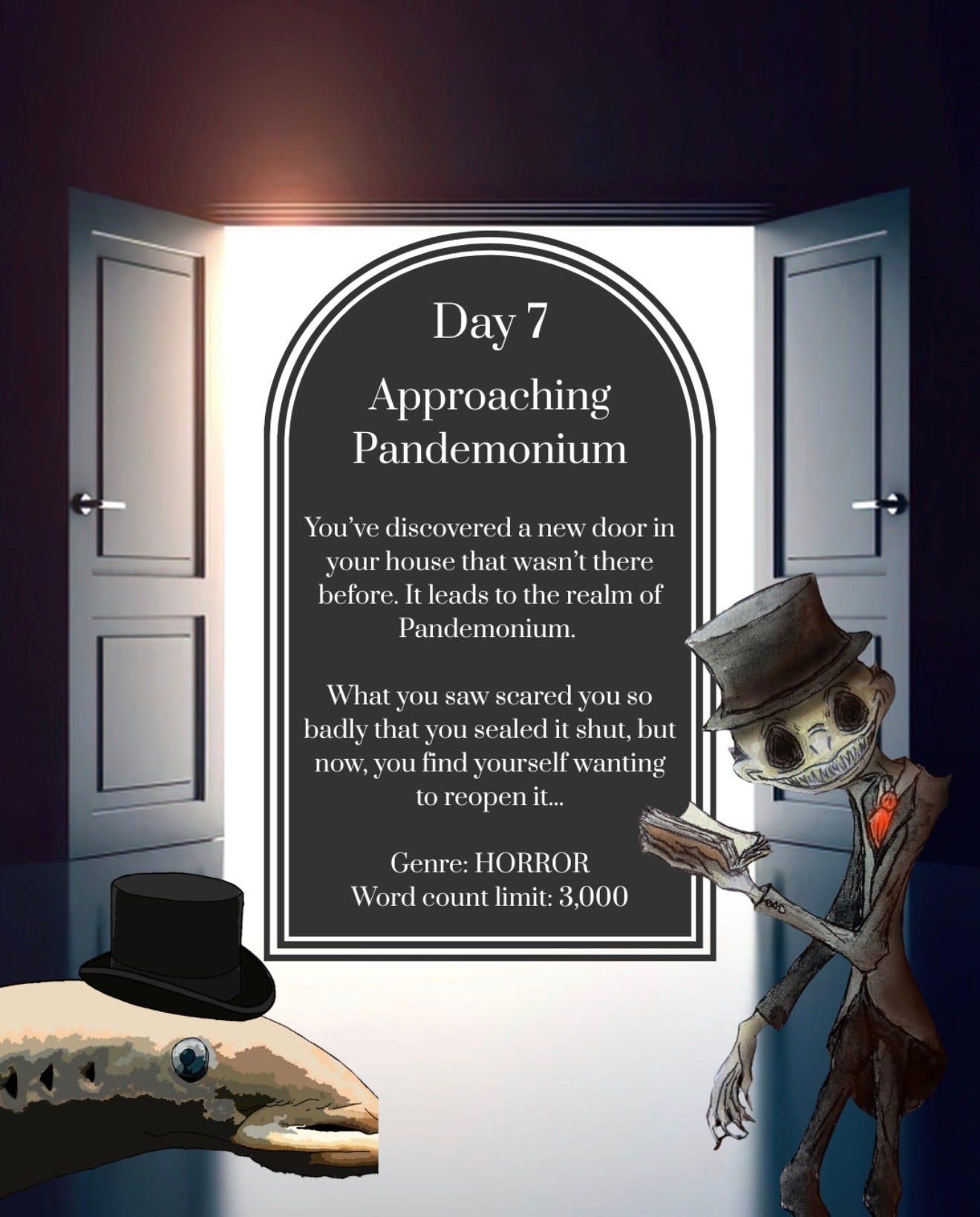
This was written for Bradley Ramsey’s Halls of Pandemonium writing challenge. Today’s prompt was…
…
You’re right, horror is often in those strange unsettling moments, not the monster.
Or even need a monster.
🖤