

An inspection is supposed to show you what is wrong with a house. What it really showed us was how much imperfection we were willing to accept—and what we still believed was worth caring for.
Buying a house, it turns out, happens in bursts. For a while everything moves at once. You look at listings, walk through rooms, talk through possibilities, make an offer, sign papers, answer questions, and send documents to people whose names you have only recently learned. Then the inspection is finished, the sellers respond, and the whole process seems to stop.
We are in that quiet space now, waiting for the appraiser to come out and tell the lender what the house is worth. There is nothing for us to sign today and no new decision waiting in our inbox. The next step belongs to someone else, which means all we can do is wait while our minds continue moving into a house our bodies are not yet allowed to occupy.
We already talk about it as though we live there. We know which room will become the library and where the furniture might go. I have imagined tools hanging on the garage wall, fresh paint covering colors we do not like, and a fence surrounding the yard. In our heads, we have crossed the threshold many times.
The inspection interrupted some of that imagining, which is exactly what an inspection is supposed to do. A showing encourages you to notice the light coming through the windows, the size of the rooms, and the possibilities hidden beneath somebody else’s furniture. An inspector notices the outlet wired backward, the plumbing that leaks, the wood beginning to fail, and the small openings where water, insects, or time may eventually find their way inside.
The report was not catastrophic, but it was not short. There were electrical repairs, plumbing concerns, damaged siding on the garage, aging smoke detectors, leaking exterior faucets, and smaller projects scattered throughout the house. Some things will need attention soon. Others can wait until we have the time and money to deal with them properly.
The sellers agreed to repair the broken front door frame, which mattered because it was not simply an ugly piece of trim. Someone had kicked the door in at some point, splitting the jamb where the deadbolt should have made the house secure. It was the one item we felt needed to be repaired before we took responsibility for everything else.
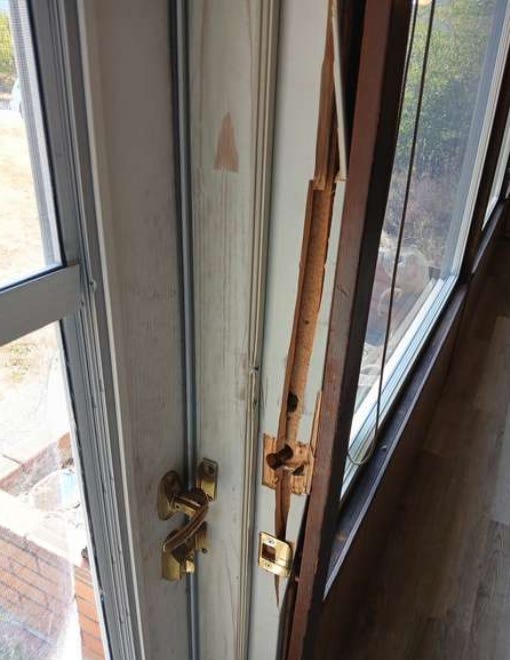
The damaged front door jamb was the one repair we asked the sellers to complete.
Beyond that, we said yes. We did not say yes because the house was perfect or because the report contained nothing that concerned us. We said yes because none of the problems changed what we believed the house could become.
One of the first things this process has taught us is that “no money down” does not mean no money out of pocket. It means there may not be a traditional down payment. It does not mean you arrive at the closing table without having spent anything along the way.
There was earnest money, the inspection fee, and the cost of moving money from one account to another. There will probably be more before this is finished. None of those expenses were hidden from us, but there is a difference between knowing costs exist and watching them leave your bank account one after another.
I think the phrase “no money down” creates an image of walking into a closing office with empty pockets and walking out with a house. The reality is less dramatic and more expensive. Even when the loan does not require a down payment, you still need enough room in the budget for the smaller costs that gather around the edges.
The inspection taught us something more important than that, though. Every buyer eventually has to decide how much unfinished is too much.
Someone else could read the same report and decide the house asked more of them than they wanted to give. They might want to move in, unpack their boxes, hang a few pictures, and spend their weekends resting. A house with repairs waiting in several directions would feel less like an opportunity and more like a burden.
That would not make them wrong. It would simply mean this was not the right house for them.
For us, the calculation was different. I do not look forward to every repair, and I am not pretending that crawling beneath a house or opening a wall is some kind of spiritual experience. There will be projects that take longer than expected, cost more than planned, and leave me wondering why anyone ever thought homeownership was a good idea.
Still, I like learning how things work. I like taking something neglected and giving it another chance. I can look at damaged trim, aging paint, or an unfinished garage and imagine the work ahead without immediately feeling defeated by it.
As I read through the report, I found myself sorting the problems into categories. Some were urgent. Some were irritating. Some were simply the predictable wear of a house that has been standing for nearly sixty years. Slowly, the list stopped looking like proof that we should walk away and began looking like a map of the work that would become ours.
That does not make the problems smaller. It only means we decided they fit within our abilities, our budget, and the kind of future we wanted to build.
Everyone has to make that decision for themselves. The question is not whether a house has flaws, because every house does. Some wear them openly, while others hide them beneath fresh paint and new flooring. The real question is whether you can look honestly at what is there and decide that it is still worth the effort.
I suppose the same is true of people.
We often meet one another after some of the damage has already been done. We see the places where someone was neglected, where trust was broken, or where life came through the door harder than it should have. Some wounds are obvious. Others remain hidden until someone has been present long enough to notice them.
It is easy to care for what arrives polished and undemanding. It is harder when care requires patience, steady effort, and the willingness to learn what another person actually needs.
That does not mean we are responsible for repairing everyone we meet. People are not projects, and love should never require us to ignore harm or surrender every boundary. Care is not the same as rescue. Sometimes the most loving thing we can offer is simply attention, patience, and the refusal to mistake damage for worthlessness.
Perhaps that is why this house feels right for Second Growth. We were never looking for something flawless. We were looking for something with good bones, something that still had life in it, and something we could leave better than we found it.
We are not buying a finished house. We are accepting responsibility for a place that still needs care. There will be paint to scrape, wood to replace, leaks to stop, and rooms to bring back to life. None of those things make the house less worthy of becoming a home.
Healing may begin the same way—not with perfection or certainty, but with an honest look at what is there and a decision that it is still worth caring for.
This week, the inspection showed us the house as it really is. We looked at the work, considered what it would ask of us, and said yes.
Not because it needs nothing from us, but because we believe it is worth what we can give.
A house is never really ours. We simply care for it until it is someone else’s turn.

Second Growth follows our attempt to care for one house on the Olympic Peninsula—and what that work continues to teach us about caring for people, places, and the small part of the world within our reach.
Love this. My favorite line "Sometimes the most loving thing we can offer is simply attention, patience, and the refusal to mistake damage for worthlessness." Congratulations on your new home. I bought my second home "as is" in 2022. It too needs a lot of work, but I did not care. I was home after supposedly only living with relatives for a few months after my marriage ended. This house so much bigger that my first one and the previous owner left me her living room furniture, a dinette set and all the kitchen appliances. Let me tell you, after being able to move all of my belongings from my POD and my stuff from my one little room at my Father's house (May God Be Pleased With Him), it felt so good to "spread out", to take a shower in my own bathroom again and to sleep in a bedroom that did not contain everything I owned that was not in the POD. I had closets, not closet. I exhaled. And it sho' felt good. 😀😃
Sounds like a "fun" project. Maybe fun is not the right word, but satisfying. Hubby and I took on a similar project and spent a lot of effort to create a cute bungalow on the lake. Unfortunately, the bones of this house were not that great, but we did know that going in. We took the challenge and put enough "lipsitck" on that pig to make it look really good. Thrifted most of the furniture and appliances and our bargain house has been a fun summer vacation place for the last 3 years. Unfortunately, we know, sooner or later, really more sooner, the whole house will have to come down and be replaced. 🏚️