

Some grief arrives all at once.
Some arrives in portions small enough to survive.
A smell.
A song.
A receipt folded into an old coat pocket.
The sound of silverware somewhere it shouldn’t be.
Tonight’s story is about the quiet systems people build to keep themselves functioning after unbearable loss.
And the danger of staying there too long.
Welcome back to the halls beneath ordinary life.
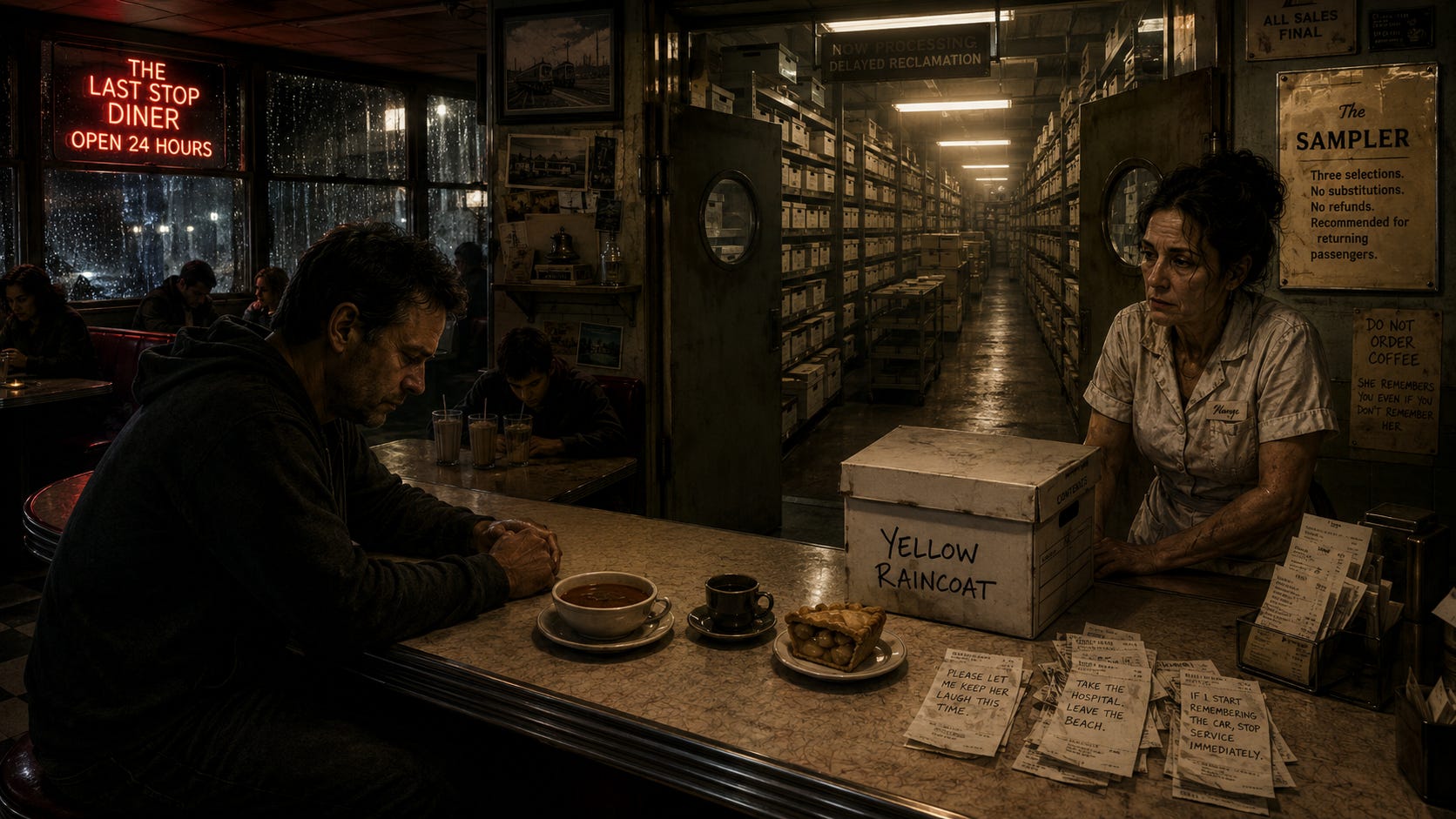
THE SAMPLER
Daniel woke because the refrigerator was humming in a different language.
Not louder.
Deeper.
The sound rolled through the apartment after midnight, low and mechanical, vibrating beneath rain, old pipes, and the fluorescent kitchen light’s dying buzz.
Daniel sat upright on the couch, disoriented. The television cast pale static across the room, muted infomercial voices whispering to nobody.
The microwave clock read 2:14 AM.
Or maybe PM.
No. Night.
Definitely night.
Probably.
The apartment had been wrong lately.
Not haunted wrong.
Administrative wrong.
Hallways changing lengths. Sticky notes in his own handwriting he could not remember writing. Trains beneath the building.
The transit inventory sheets still sat folded inside the suitcase near the closet.
TRAVELERS ARE ADVISED TO PACK LIGHT.
Daniel crossed the kitchen. Rainwater shadows trembled against the cabinets from passing headlights outside.
For one second, the moving light looked like windshield wipers dragging across wet glass.
Daniel stopped.
The image vanished before he could understand why it hurt.
He touched the refrigerator handle.
The humming stopped.
Silence swallowed the apartment.
Then, from inside the refrigerator:
Silverware clinking.
Daniel jerked backward.
Logic tried to reclaim the room.
Exhaustion. Auditory distortion. Stress. Neurological drift.
The doctor had used phrases like that carefully, as though speaking too directly might cause him to fracture further.
Daniel opened the refrigerator.
Cold air rolled across his face carrying the smell of mustard, leftovers, stale vegetables…
…and coffee.
Fresh coffee.
Diner coffee.
Behind the shelves came the low murmur of voices. A roomful of them. Dishes. Rain. A woman laughing somewhere far away.
Then:
“Order up.”
The voice crackled like an old overhead speaker.
Daniel slammed the door.
His pulse hammered against his ribs.
Then he noticed something tucked beneath the lighthouse magnet on the freezer door.
A receipt.
THE LAST STOP DINER
OPEN 24 HOURS
Below that:
SAMPLER SPECIAL
THREE SELECTIONS
NO SUBSTITUTIONS
Then, handwritten near the bottom:
YOU LEFT BEFORE THE THIRD COURSE LAST TIME.
Last time.
The kitchen light dimmed.
The apartment smelled faintly of cigarette smoke and burnt coffee.
Daniel opened the refrigerator again.
The shelves were gone.
Cold fluorescent light stretched inward far beyond the appliance. A narrow maintenance corridor extended into impossible distance, lined with damp concrete walls and overhead pipes sweating condensation.
At the far end glowed a red EXIT sign.
Not supernatural.
Institutional.
Daniel looked back toward the couch, the sticky notes, the half-empty boxes near the wall.
CALL PHARMACY.
TAKE MEDICATION.
DO NOT FALL ASLEEP ON COUCH AGAIN.
His ordinary life looked staged. Thin. A temporary waiting room pretending to be permanence.
He should have walked away.
Instead, he stepped inside.
The apartment sounds vanished behind him.
Only distant conversations and the low thunder of trains moving somewhere beneath reality.
Someone had scratched words into the concrete beside one of the lights.
DO NOT ORDER COFFEE.
Below that:
SHE REMEMBERS YOU EVEN IF YOU DON’T REMEMBER HER.
The woman in the yellow raincoat surfaced briefly inside his mind.
Blurred face. Wet train platform. Crying.
Gone before he could hold onto it.
The corridor turned. Warm amber light spilled across the floor. Old jazz crackled through damaged speakers.
Daniel rounded the corner and saw the diner.
It sat impossibly beneath the building like something forgotten between decades. Chrome stools. Red vinyl booths. Fogged windows showing only darkness beyond them. A flickering neon sign behind the counter:
THE LAST STOP DINER
OPEN 24 HOURS
The place was nearly full.
Occupied.
Tired people stared into coffee cups and plates they did not seem to want. A woman in hospital scrubs reread the same photograph. A teenage boy sat alone with three untouched milkshakes, whispering the same name like repetition could nail it in place.
Behind the counter stood the waitress.
Mid-fifties maybe. Dark hair pinned loosely up. White uniform slightly yellowed with age. Coffee pot already in hand.
She looked directly at Daniel without surprise.
Then smiled softly.
“Welcome back,” she said.
Daniel did not sit down.
“I’ve never been here.”
“Most people say that the first few times.”
Around them, the diner continued its low ritual. Forks touched plates. Coffee poured. Somewhere behind the kitchen doors, a bell dinged.
Order up.
Daniel looked toward the entrance behind him.
The corridor was gone.
In its place stood an ordinary glass door with a CLOSED sign turned backward. Beyond the glass, rain slid down in silver lines across darkness.
He stepped toward it.
“Returning customers are advised not to exit before service,” the waitress said.
Daniel stopped with his hand inches from the handle.
“Advised by who?”
“The house.”
“The house?”
She gave him a sympathetic look, which made it worse.
“Policy language. Nobody likes it.”
“What is this place?”
She reached beneath the counter and pulled out a laminated menu.
“The Last Stop Diner.”
“I can read.”
“Then you’re doing better than some.”
Most items were ordinary enough to feel insulting.
Eggs. Toast. Black coffee. Tomato soup. Apple pie. Pancakes after midnight.
Beneath all of it, framed in a thin black box, was the item from the receipt.
THE SAMPLER
Three selections.
No substitutions.
No refunds.
Recommended for returning passengers.
“I’m not hungry.”
“That rarely matters.”
“I don’t want anything.”
The waitress’s expression softened into something almost human.
“Nobody comes here because they want something,” she said. “They come because something wants out.”
Through the round porthole window in the kitchen doors, Daniel saw storage shelves, long aisles disappearing into fluorescent distance, thousands of cardboard boxes.
Then someone passed behind the glass and the image vanished.
“I need to go home,” Daniel said.
“You did.”
The words landed quietly.
Factual.
The waitress poured coffee into a mug he had not noticed.
The smell hit him at once.
Burnt. Bitter. Familiar.
“No coffee.”
She paused.
“You read the wall.”
“Who wrote it?”
“You did.”
Of course.
He laughed once, sharp and humorless, because the alternative was screaming in a diner full of people who looked too tired to care.
The bell rang again.
The waitress turned, took three small plates from the pass window, and set them on the counter.
A shallow cup of tomato soup.
A small black espresso cup, empty except for a dark stain.
A forkful of apple pie on a white saucer.
Ordinary food.
That made it obscene.
“Compliments of the house.”
“I didn’t order this.”
“You have before.”
Daniel stared at the soup.
Steam curled from it gently.
The smell rose into him and unlocked something behind his ribs.
Snow.
Blue dusk pressed against kitchen windows.
His mother standing at the stove in a robe, stirring soup from a can because school had been canceled and the roads were bad. The television in the next room glowing with cartoons. Socks damp from playing too long outside. That perfect animal certainty that the world, however cold, still had a center.
Daniel gripped the counter.
The memory came fully.
Whole.
Then the memory folded itself back into him and the diner returned.
His eyes stung.
The soup remained untouched.
“What did you do?”
“We haven’t done anything yet,” she said. “You’re only smelling it.”
“I don’t want this.”
“That’s allowed.”
The waitress took a receipt pad from her apron pocket.
“But refusal still has to be recorded.”
Daniel leaned over the counter.
CUSTOMER DECLINED INITIAL RECLAMATION.
Beneath that, three boxes:
NOSTALGIA.
FEAR.
TRUTH.
“I’m not signing anything.”
“You already have.”
She tore off the receipt.
His signature sat at the bottom.
Old. Faded.
Beside it, written in his own hand:
IF I COME BACK, MAKE ME START WITH SOUP.
Daniel sat down because his knees had stopped being loyal.
“What happens if I eat it?”
“You recover what survived transit.”
“And what do I lose?”
“Equal exchange.”
“Meaning?”
“Meaning people don’t get to carry everything.”
At the end of the counter, an old man whispered, “I used to have a brother.”
Nobody looked at him.
Daniel looked at the soup.
“What did he order?”
“Toast.”
“That took his brother?”
“That returned his brother,” she said. “For a minute.”
The cruelty of that was so clean Daniel almost admired it.
“No.”
The waitress nodded.
“Then we move to the second selection.”
“I said no.”
“The Sampler is three selections.”
“I didn’t order the Sampler.”
She tapped the receipt.
“You did.”
“I don’t remember.”
“That is the common problem, yes.”
Daniel stood.
“I’m done.”
The diner went quiet.
A hundred small sounds vanished.
“Mr. Mercer,” the waitress said softly, “leaving before service is what caused the leakage.”
“The what?”
“Hallways lengthening. Appliances opening into corridors. Announcements in plumbing. Memory displacement in domestic spaces.”
Daniel went still.
“You’re saying this is my fault?”
“I’m saying your account remains open.”
The diner resumed around them.
Daniel slowly sat again.
The waitress picked up the tiny espresso cup.
“What is that?”
“Fear.”
“I guessed that.”
“This one restores the next thing you keep reaching for.”
The woman in the yellow raincoat.
His chest tightened.
“Careful,” she said. “Anticipation counts.”
She tipped the empty espresso cup toward him.
A single black drop slid from the bottom and fell onto the saucer.
The smell hit first.
Hospital coffee.
Waiting room carpet damp from rain.
Vending machine light buzzing near a hallway.
Daniel’s vision blurred.
A little girl slept across two chairs under his coat. Her hair was tangled from crying. One sneaker had come untied.
A woman in a yellow raincoat stood near the windows with both hands wrapped around a paper cup she wasn’t drinking from.
Her face was still blurred.
But less now.
Enough to see her mouth trembling.
“You said we had more time,” she whispered.
Daniel heard himself answer.
“I thought we did.”
The woman laughed once, and the sound had no life in it.
“You always think that.”
Somewhere down the corridor, a monitor screamed.
The memory ripped away.
Daniel came back to the diner gripping the counter.
The tiny espresso cup sat upright again.
Empty.
“Who is she?” Daniel whispered.
“That requires consumption.”
Daniel almost reached for the cup.
Then he saw another receipt tucked beneath the napkin dispenser.
His handwriting.
DANIEL, READ BEFORE SECOND COURSE.
He unfolded it.
DO NOT LET THEM TURN LONGING INTO EVIDENCE.
Below that:
YOU ARE NOT HERE TO SOLVE HER.
YOU ARE HERE TO SURVIVE WHAT YOU ALREADY KNOW.
“What’s her name?” he asked.
“I can’t tell you that.”
“Can’t or won’t?”
“Policy.”
He slammed his hand against the counter.
“What is her name?”
The kitchen bell rang.
This time every head in the diner turned toward the kitchen.
The waitress’s expression changed.
“You need to decide before the third selection arrives.”
“I already decided.”
“No. You avoided deciding. That’s different.”
Daniel looked around.
The old man had stopped whispering about his brother. Now he stared at his hands as if they belonged to someone else. The teenager with the milkshakes had gone silent too. Whatever name he had been repeating was already gone.
This was not a restaurant.
It was a place people came to bleed carefully.
A processing station for grief dressed up as comfort food.
Behind the kitchen doors, something heavy rolled across tile.
“For whatever it’s worth,” the waitress said, “you usually apologize before this part.”
His anger drained.
“Apologize to who?”
She did not answer.
The kitchen doors swung open.
Warm amber light spilled across the diner floor.
A young busboy stepped out pushing a metal cart. On it sat a small cardboard archive box.
White.
Labeled in black marker.
YELLOW RAINCOAT.
Daniel stopped breathing.
The waitress placed the apple pie saucer on top of the box.
“Third course.”
Something inside shifted softly.
Not an object.
A memory turning in its sleep.
“What’s inside?” Daniel asked.
The waitress folded her receipt pad closed.
“You.”
The pie was barely two bites. Steam rose through the crust carrying cinnamon and butter and something deeper underneath.
Recognition.
Birthday candles.
A roadside diner after midnight.
A little girl asleep against his shoulder while rain tapped the windows.
The woman in yellow laughing softly and saying, “You always order dessert when things are bad.”
Daniel shut his eyes.
Too late.
Wet highways.
Hospital fluorescent lights.
A tiny shoe abandoned beneath a chair.
The woman in yellow gripping the steering wheel hard enough for her knuckles to pale.
Then:
A child coughing in the backseat.
Daniel opened his eyes sharply.
The waitress watched him with open pity.
“That wasn’t part of the sample.”
“What happened to them?”
No answer.
“What happened?”
“You keep asking outcome questions before identity questions.”
“What does that mean?”
“It means your grief arrived intact before your memory did.”
An announcement crackled overhead.
“Now processing delayed reclamation…”
Static swallowed the rest.
The waitress nodded toward the pie.
“You should finish before the platform shift.”
“What happens if I eat it?”
“You remember.”
“And then?”
“You decide whether keeping it is survivable.”
Daniel stared at her.
“You mean people come here to forget on purpose.”
“Sometimes.”
“And the rest?”
“They come here because forgetting happened anyway.”
A cup shattered somewhere in the back.
Nobody reacted.
The waitress leaned closer.
“There are only two kinds of passengers who make it this far, Mr. Mercer. The ones desperately trying to remember, and the ones desperately trying not to.”
Daniel looked down at the pie.
“I still don’t know what happened.”
“You know enough.”
“No I don’t. I have pieces. Hallways. Notes. Trains. Her coat. A hospital. That’s not enough.”
The waitress looked tired suddenly.
Not mystical. Not eerie. Just deeply, catastrophically tired.
“That’s because you keep trying to approach grief like a detective,” she said. “But grief isn’t a mystery. It’s weight.”
The fluorescent lights flickered.
For one terrible second, the diner vanished.
Daniel saw endless corridors, black doors, arrival boards clattering overhead, passengers drifting through fluorescent light carrying suitcases, boxes, photographs, plastic grocery bags.
Fragments of lives.
Then reality snapped back.
Diner.
Coffee.
Pie.
“What is this place?” Daniel asked.
The waitress looked around softly.
“A pressure valve.”
“For what?”
“For people who would otherwise drown carrying themselves.”
The answer landed harder than anything else because it felt true.
The waitress tapped the pie.
“This is the closest you’ve ever come to remembering voluntarily.”
“What does that mean?”
“It means usually by this point you ask us to take it away.”
Daniel looked at the receipts beside the soup bowl.
Stacks now.
Dozens.
All with his handwriting.
PLEASE LET ME KEEP HER LAUGH THIS TIME.
TAKE THE HOSPITAL. LEAVE THE BEACH.
IF I START REMEMBERING THE CAR, STOP SERVICE IMMEDIATELY.
The waitress gently slid them back into the pile.
“You were trying to portion the grief,” she said.
“Can you do that?”
“For a while.”
Daniel understood then.
Not fully.
Enough.
He had not been removing the grief. He had been slicing it smaller. Making it meal-sized. Carryable. A spoonful of beach. A swallow of hospital. One laugh retained, one scream surrendered.
The pie smell deepened.
Cinnamon.
Butter.
Rain.
And beneath it now:
Wet asphalt.
A road at night.
Windshield wipers struggling against heavy rain.
The little girl coughing again from the backseat.
The woman in yellow saying, “We should pull over.”
Daniel gripping the wheel tighter.
“We’re almost there.”
Headlights.
A truck horn.
White light exploding across wet glass.
Daniel gasped and lurched backward off the stool.
The diner tilted violently.
“Daniel,” the waitress said.
But he was already remembering now.
Not clearly.
Enough.
Hospital waiting room.
The little girl never waking up.
The woman in yellow blaming him because he blamed himself first.
Months of drowning afterward.
Arguments.
Silence.
The slow collapse of a marriage beneath unbearable shared gravity.
And finally:
Pandemonium.
Not a city.
Not a terminal.
A system people found when grief became too large to carry cleanly.
Daniel gripped the counter.
“I came here to forget her.”
The waitress said nothing.
“She was my daughter.”
The words barely emerged.
Broken.
The waitress lowered her eyes.
“Yes.”
The diner softened around him. Cups. Rain. Quiet crying. The endless tired machinery beneath the floor.
Daniel stared at the pie.
Truth.
Not revelation.
Weight.
All this time he had treated the missing memories like stolen property. Something taken from him by an external force.
But that wasn’t what happened.
He had surrendered them.
Piece by piece.
Because surviving the full shape of the loss had once seemed impossible.
The waitress slid one final receipt across the counter.
Fresh paper.
Blank except for a question.
WHAT WOULD YOU LIKE TO LEAVE BEHIND TONIGHT?
Daniel stared at it.
His daughter laughing at the beach.
The hospital monitor screaming.
The woman in yellow standing in rain beside a train platform.
The unbearable knowledge that one terrible impatient decision had split his life into Before and After forever.
Behind the kitchen doors, archive shelves stretched endlessly beneath amber light.
Thousands of boxes.
Thousands of people trying to survive themselves.
Daniel picked up the pen.
His hand trembled.
“Most people choose the sharpest part,” the waitress said.
“The sharpest part is all of it.”
“Yes.”
The jukebox skipped backward again.
Three trumpet notes.
Reset.
Three trumpet notes.
Reset.
Daniel looked around the diner one final time.
At the exhausted passengers.
At the receipts.
At the little rituals people performed to keep themselves from collapsing completely.
Then he looked back at the blank receipt.
Slowly, carefully, he wrote:
NOTHING.
The waitress read it.
For the first time since he arrived, she looked surprised.
“You understand what that means?”
Daniel nodded weakly.
“No more portions.”
The hum beneath the diner deepened.
Somewhere beyond the walls, trains screamed through darkness.
The waitress took the receipt gently from his hand.
After a long silence, she smiled.
Not professionally this time.
Sadly.
Like someone watching a patient refuse anesthesia before surgery.
“Alright,” she whispered.
Behind the kitchen doors, the archive shelves began to open.
Box lids lifted in endless rows.
Receipts fluttered beneath fluorescent light.
Somewhere deep in storage, a little girl laughed.
Daniel closed his eyes.
And for the first time since Pandemonium found him, he did not ask anyone to make it stop.

Maybe that’s the real horror.
Not monsters.
Not hidden corridors beneath the world.
But the possibility that somewhere inside ourselves, we are all portioning pain into manageable servings just to make it through another day.
A spoonful of nostalgia.
A swallow of fear.
One memory kept.
One memory surrendered.
And maybe healing begins the moment we stop asking to feel less.
If this one lingered with you, let me know what line stayed behind after the lights came back on. 🕯️
This was written for Bradley Ramsey’s Halls of Pandemonium writing challenge. Today’s prompt was…
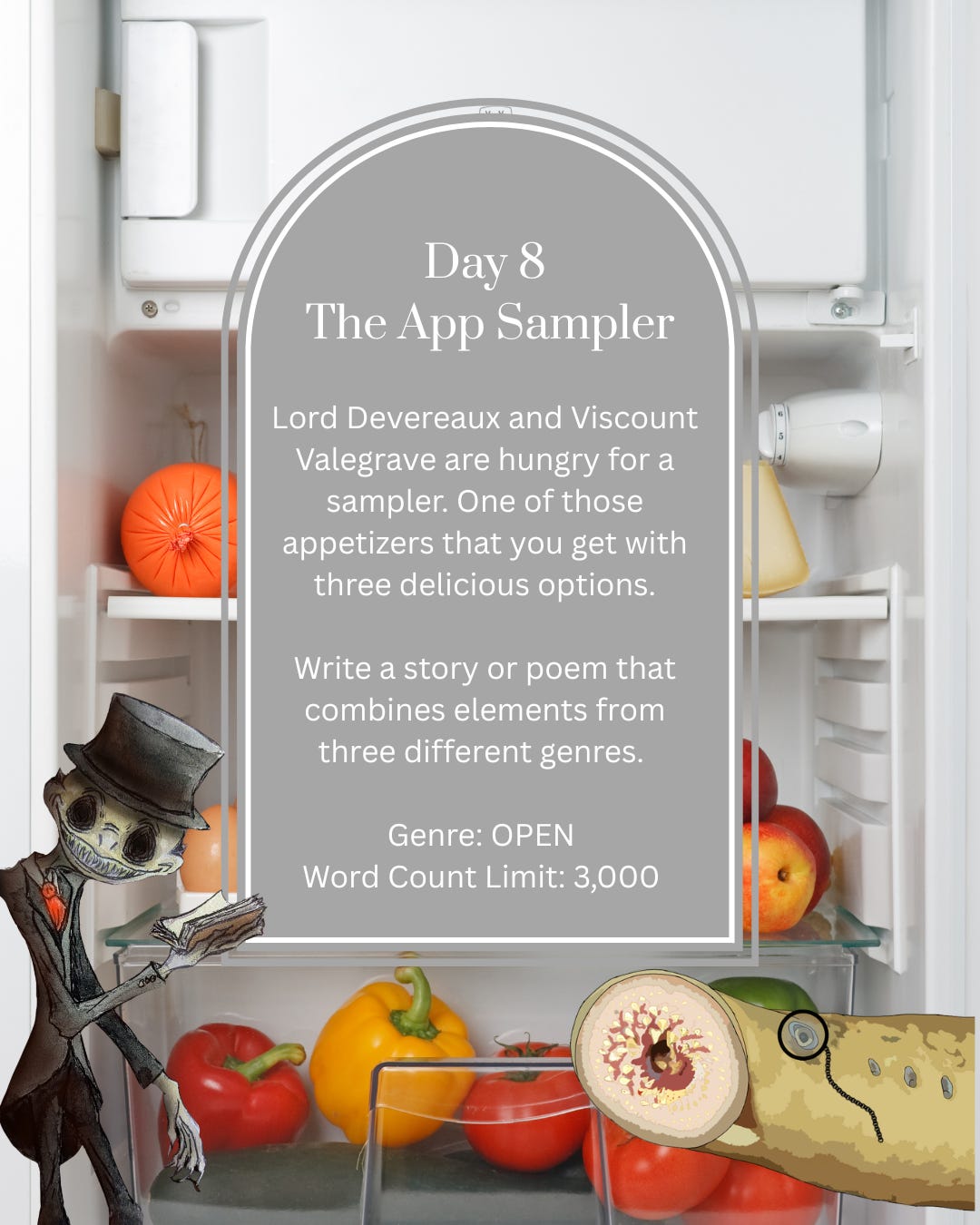
…
That was wonderful. Kept me gripped. The sort of thing you do so well. Excellent stuff.